
Emotional intelligence sounds like a single trait, but it is really built from five distinct skills that work together. Some people are naturally strong in one area and weaker in another, which is exactly why understanding each component separately makes it far easier to know where to actually focus your effort.
This guide breaks down each of the five components, what it looks like in daily life, and a simple way to start strengthening it.
Where the framework comes from
The five component model was popularized by psychologist Daniel Goleman in the 1990s, drawing on earlier academic research into emotional and social intelligence. It remains the most widely referenced framework for understanding emotional intelligence today, largely because each component maps cleanly onto observable, everyday behavior.
Component one, self awareness
Self awareness is the ability to accurately notice your own emotions as they happen, along with understanding how those emotions shape your thoughts, decisions, and behavior. Without this component, the other four are difficult to build, since you cannot regulate or use information you have not yet noticed.
In daily life, this looks like recognizing that a sharp reply to a coworker actually came from stress carried over from an earlier meeting, rather than from anything the coworker did.
Component two, self regulation
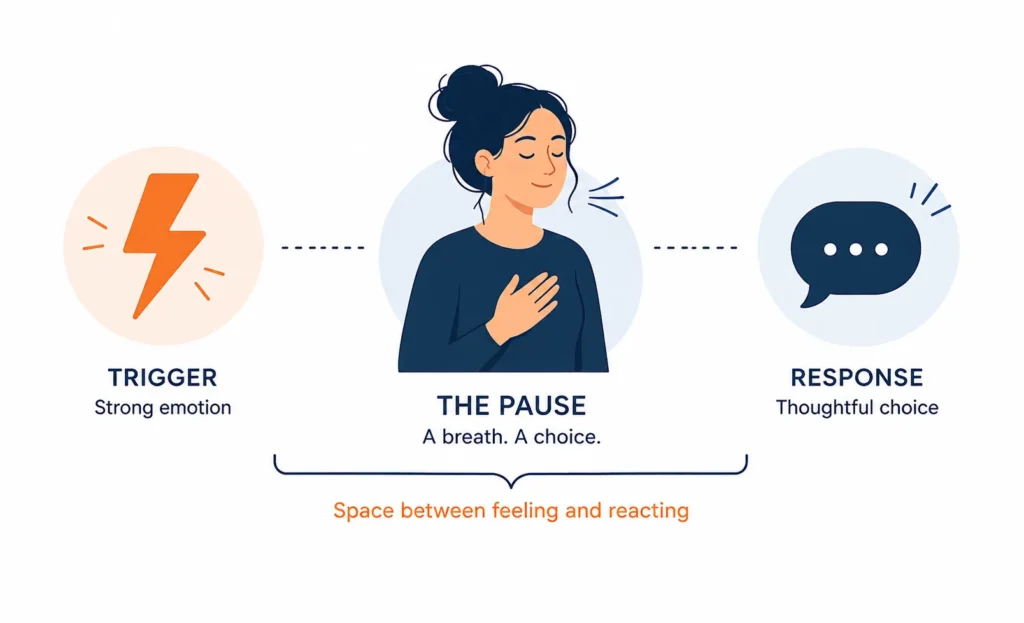
Self regulation is the ability to manage disruptive emotions and impulses rather than reacting to them automatically. It does not mean suppressing emotions, it means creating enough space between feeling something and acting on it to choose a more useful response.
A person with strong self regulation might still feel frustrated during a tense meeting, but they pause before responding instead of snapping, which changes the entire outcome of the conversation.
Component three, motivation
In the context of emotional intelligence, motivation refers to an internal drive to pursue goals for reasons beyond money, status, or approval, combined with resilience when things do not go as planned. People strong in this component tend to stay engaged through setbacks rather than losing momentum after the first obstacle.
Component four, empathy
Empathy is the ability to sense what other people are feeling, even when they have not stated it directly, and to respond to it appropriately. This is different from sympathy, empathy involves actually understanding someone’s emotional state well enough to respond to it accurately, not just feeling sorry for them.
A manager with strong empathy might notice a normally talkative team member has gone quiet in meetings, and check in privately rather than assuming nothing is wrong.
Component five, social skills
Social skills bring the other four components together into the ability to build rapport, manage relationships, and navigate group dynamics effectively. This includes clear communication, conflict management, and the ability to influence or inspire other people without relying on authority alone.
How the five components show up differently at work versus at home
The same five components can look quite different depending on context. Self regulation at work might mean staying calm during a tense client call, while at home it might mean not snapping at a partner after a long day. Empathy at work often means reading a colleague’s stress level before assigning a new task, while at home it might mean noticing a child is upset about something they have not said out loud yet.
Recognizing that these components apply everywhere, not just in professional settings, tends to make the framework feel less like a workplace skill and more like a general life skill worth developing across every relationship.
Real life example, how priya identified her weakest component
Priya, a 30 year old project manager, considered herself emotionally intelligent because she was well liked and rarely got visibly upset. After reading about the five components, she realized her strength was social skills, but her self regulation was actually weak, she simply avoided situations that would have tested it, rather than genuinely handling them well.
Once she identified the actual gap, she started practicing a short pause before responding during disagreements instead of immediately smoothing things over to avoid discomfort. Within a few months, she found she could stay engaged in harder conversations instead of quietly steering away from them, which is what she had been doing for years without realizing it.
Your component by component starter plan
- Step 1: Rate yourself honestly from 1 to 5 on each of the five components before assuming you know your strongest and weakest area.
- Step 2: Pick the single lowest scoring component and focus on it alone for the next month, rather than trying to improve all five at once.
- Step 3: Ask one trusted person which component they would say is your weakest, and compare it honestly to your own rating.
- Step 4: Revisit your ratings after one month to see which component actually shifted.
Common mistakes people make with this framework
- Assuming strength in one component, often social skills, means strength across all five
- Trying to improve all five components at once instead of focusing on the weakest one first
- Confusing empathy with agreeing or simply being nice, rather than accurately understanding emotions
- Treating self awareness as a one time realization instead of an ongoing practice
These five components sit inside a larger picture of what emotional intelligence actually is. The complete guide to what is emotional intelligence covers how the concept developed and how it compares to traditional IQ.
If you want a faster way to assess where you stand, signs you have high emotional intelligence offers a broader checklist that draws on all five components covered here.
For a much deeper look at the first and arguably foundational component, what is self awareness in emotional intelligence walks through specific exercises to strengthen it.
Recommended resources
A couple of resources that pair well with this framework:
The original book that introduced this five component framework in detail, with extensive research and case studies.
Useful for the self rating exercise described in the action steps above, particularly for tracking self awareness over time.
Frequently asked questions
What are the five components of emotional intelligence?
Self awareness, self regulation, motivation, empathy, and social skills, according to the framework popularized by psychologist Daniel Goleman.
Which component of emotional intelligence is most important?
Self awareness is often considered foundational, since it is difficult to regulate or apply the other components without first accurately noticing your own emotions.
Can someone be strong in one component and weak in another?
Yes, this is common. Someone can have excellent social skills while still struggling with self regulation, or strong empathy while lacking self awareness.
Is empathy the same as being a kind person?
Not exactly. Empathy specifically involves accurately understanding what someone else is feeling, while kindness is a behavior that may or may not be based on accurate emotional understanding.
How do I know which component I am weakest in?
Honest self rating combined with feedback from someone you trust tends to reveal gaps more accurately than self assessment alone, since blind spots are, by definition, hard to see on your own.
Can these five components be developed at any age?
Yes. Unlike IQ, all five components can be meaningfully strengthened through practice and feedback, regardless of age.
Treating emotional intelligence as five separate, learnable skills rather than one fixed trait makes it far more actionable. Identify your weakest component honestly, focus on it deliberately, and the overall picture of your emotional intelligence improves from there, one piece at a time.