
For most of the twentieth century, IQ was treated as the single best predictor of how far someone would go in life. Then researchers started noticing something inconvenient for that theory, plenty of high IQ people struggled in careers and relationships, while others with more average test scores consistently outperformed them. Emotional intelligence turned out to explain a large part of that gap.
This guide compares the two directly, what each one actually measures, what the research says about predicting success, and why the most useful answer is not really about picking a winner.
What IQ actually measures
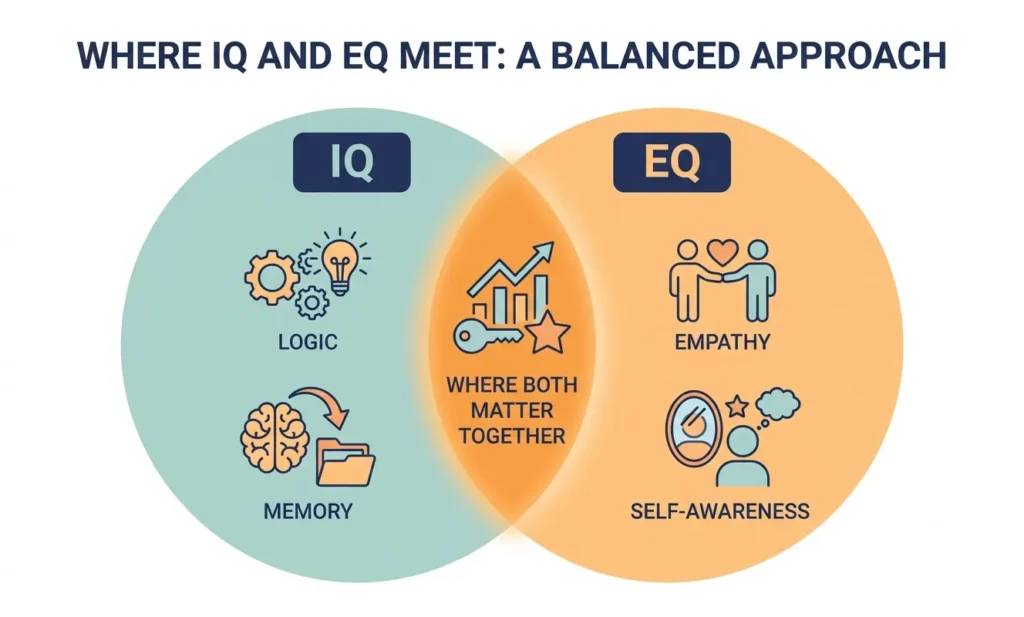
IQ, or intelligence quotient, measures cognitive abilities such as logical reasoning, memory, pattern recognition, and problem solving speed. It is a strong predictor of academic performance and technical skill acquisition, and it tends to remain relatively stable throughout adulthood.
What emotional intelligence actually measures
Emotional intelligence measures how well you recognize, understand, and manage your own emotions, along with how effectively you recognize and respond to the emotions of other people. Unlike IQ, it can be meaningfully developed well into adulthood with deliberate practice.
What the research actually says
Studies in organizational psychology have repeatedly found that IQ predicts entry into a field reasonably well, since certain technical roles genuinely require strong cognitive ability. However, once people are already working in similar roles with broadly comparable IQ, emotional intelligence becomes a stronger predictor of who advances into leadership, who retains clients, and who builds durable professional relationships.
A commonly cited estimate from workplace research suggests emotional intelligence accounts for a significant share of what separates high performers from average performers in roles involving people management, often outweighing the contribution of IQ once a baseline cognitive threshold is met.
Where IQ still matters more
- Technical fields requiring deep specialized knowledge, such as engineering or advanced research
- Tasks involving complex problem solving under time pressure with little interpersonal component
- Academic environments where test based performance is the primary measure of success
Where emotional intelligence tends to matter more
- Leadership roles, where influencing and motivating other people determines outcomes
- Sales and client facing roles, where trust and rapport directly affect results
- Long term career advancement, where promotion often depends on how well you work with others, not just individual output
- Personal relationships, where technical intelligence has little bearing on connection or conflict resolution
Why the smartest person in the room is not always the most successful
A high IQ can get someone into a room, a competitive program, a technical role, a leadership track, but it rarely keeps them there or moves them further on its own. Once inside that room, success increasingly depends on reading people accurately, managing your own reactions under pressure, and building relationships that hold up during disagreement, all of which fall squarely under emotional intelligence rather than raw cognitive ability.
Real life example, two engineers with very different trajectories
Two engineers, both hired the same year at a mid sized tech company, had nearly identical technical assessment scores during hiring. One, highly skilled technically, struggled to accept feedback without becoming visibly defensive, and rarely checked in on how proposed changes would affect other teams. The other, similarly skilled technically, consistently asked how decisions would land with other departments before finalizing them, and stayed composed when his own ideas were challenged.
Three years later, the second engineer had moved into a technical lead role managing a small team, while the first remained in an individual contributor position, still highly capable technically but repeatedly passed over for advancement, largely due to how he was perceived to handle pressure and feedback rather than any gap in technical skill.
Your starter plan for building both
- Step 1: If your role is highly technical, keep sharpening IQ linked skills through deliberate practice and continued learning.
- Step 2: Separately, track one interpersonal interaction daily where you consciously practiced patience or active listening.
- Step 3: Ask a trusted colleague how you tend to respond to feedback or disagreement, and compare it honestly to how you think you respond.
- Step 4: Revisit both skill sets quarterly, since cognitive skills and emotional skills both benefit from consistent, deliberate practice.
Common mistakes people make in this comparison
- Treating IQ and EQ as competing rather than complementary skill sets
- Assuming a high IQ automatically translates into strong leadership or relationship skills
- Ignoring emotional intelligence entirely in technical fields where it still meaningfully affects collaboration
- Believing emotional intelligence cannot be improved the way IQ related skills can
This comparison only tells part of the story. The complete guide to what is emotional intelligence breaks down the five components that make up EQ in the first place.
For a closer look at exactly which skills make up the EQ side of this comparison, the five components of emotional intelligence explained breaks each one down individually.
To see how this comparison plays out concretely on the job, emotional intelligence in the workplace covers specific scenarios where EQ shapes outcomes more than raw cognitive ability.
Recommended resources
A couple of resources for going deeper into this comparison:
Covers much of the original research behind the claim that EQ predicts career success at least as strongly as IQ in many roles.
Useful if you want a structured starting point before working through the self assessment steps above.
Frequently asked questions
Is emotional intelligence more important than IQ?
It depends on the context. IQ tends to predict entry into technical fields more strongly, while emotional intelligence tends to predict leadership success and career advancement more strongly once people are already in similar roles.
Can emotional intelligence be improved the way IQ cannot?
Yes. IQ remains relatively stable through adulthood, while emotional intelligence can be meaningfully developed at any age through deliberate practice and feedback.
Do successful people usually have high IQ, high EQ, or both?
Most sustained high performers tend to have a baseline level of cognitive ability paired with strong emotional intelligence, rather than an extreme score in only one area.
Does IQ matter at all if emotional intelligence is so important?
Yes, particularly in technical or highly specialized fields, where a certain level of cognitive ability is genuinely required to perform the core work.
Can someone have high IQ and low emotional intelligence?
Yes, this is common, and it often shows up as technical competence paired with difficulty managing feedback, conflict, or team dynamics.
Which one matters more for leadership roles specifically?
Research consistently points to emotional intelligence as a stronger predictor of leadership effectiveness, since leadership relies heavily on influencing and understanding other people.
IQ and emotional intelligence are not competing for the same job, they measure genuinely different things, and most lasting success draws on both. IQ can open a door, but emotional intelligence tends to determine how far you get once you are through it. If you already know your cognitive strengths, building emotional intelligence is very likely the higher leverage investment for the next stage of your career.
.