
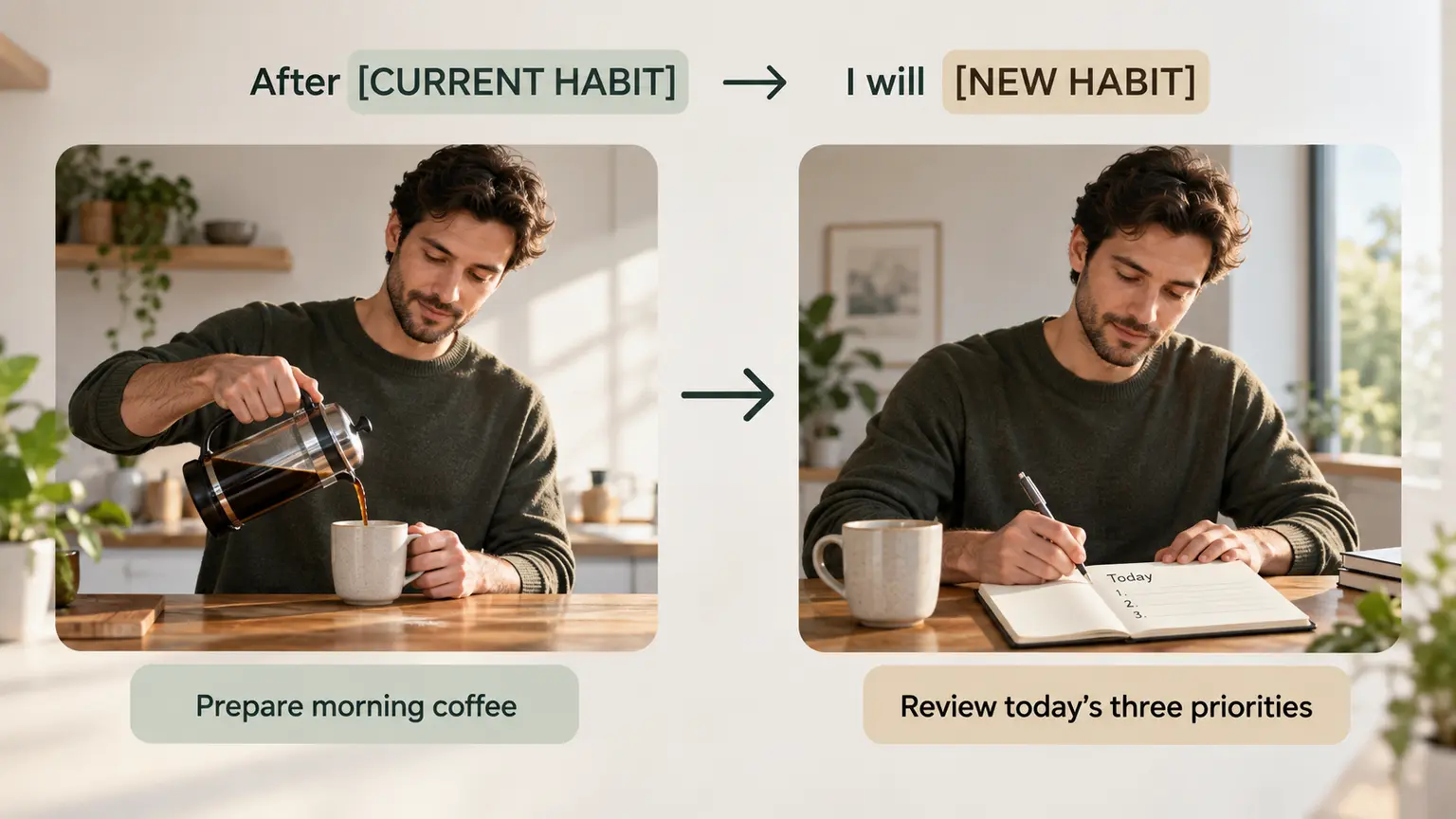
Habit stacking means using an action you already do as the cue for a new behavior. For example: after you close the lunch container, write the first task for the afternoon. The existing action identifies when to begin, so the intention does not depend entirely on remembering it at an unspecified time.
The best habit stacking examples are specific about the cue, the new action and the setting. “After breakfast, become more productive” is too vague to practice. “After putting my breakfast dish in the sink, I will write one priority on the notepad beside it” gives you something observable to test.
Start with one connection. You can create a longer routine later, but a chain of six new demands is not automatically better than one useful behavior that fits.
What the technique means, and what the research says
James Clear popularizes habit stacking as a way to attach a new behavior to an established one. It is a practical label, not a separate scientific guarantee. You do not need to claim that an action “rewires the brain” in a particular number of days to use the method sensibly.
Research on habit psychology emphasizes repeated responses in recurring contexts. Research on implementation intentions examines plans specifying an occasion and a response. Those ideas support the logic of a clear cue, but do not prove that any named stack will work for everyone.
The difference matters when troubleshooting. If the cue rarely happens or the new action needs equipment in another room, the formula alone cannot repair the mismatch. Your task is to make the connection workable in your circumstances.
The basic habit-stacking formula
Use: After I [specific existing action], I will [small new behavior]. Add the location or duration when either could be ambiguous.
For example: “After I plug in my laptop at the library, I will write the question this study session should answer.” The cue is visible, the materials are already available and the action has a clear endpoint.
Do not confuse stacking with multitasking. Listening to audio while cooking combines activities; it does not necessarily use one completed action as the cue for another. Nor is stacking the same as rewarding yourself after a difficult task. Those can be useful strategies, but they solve different design problems.
A habit stack versus a general routine
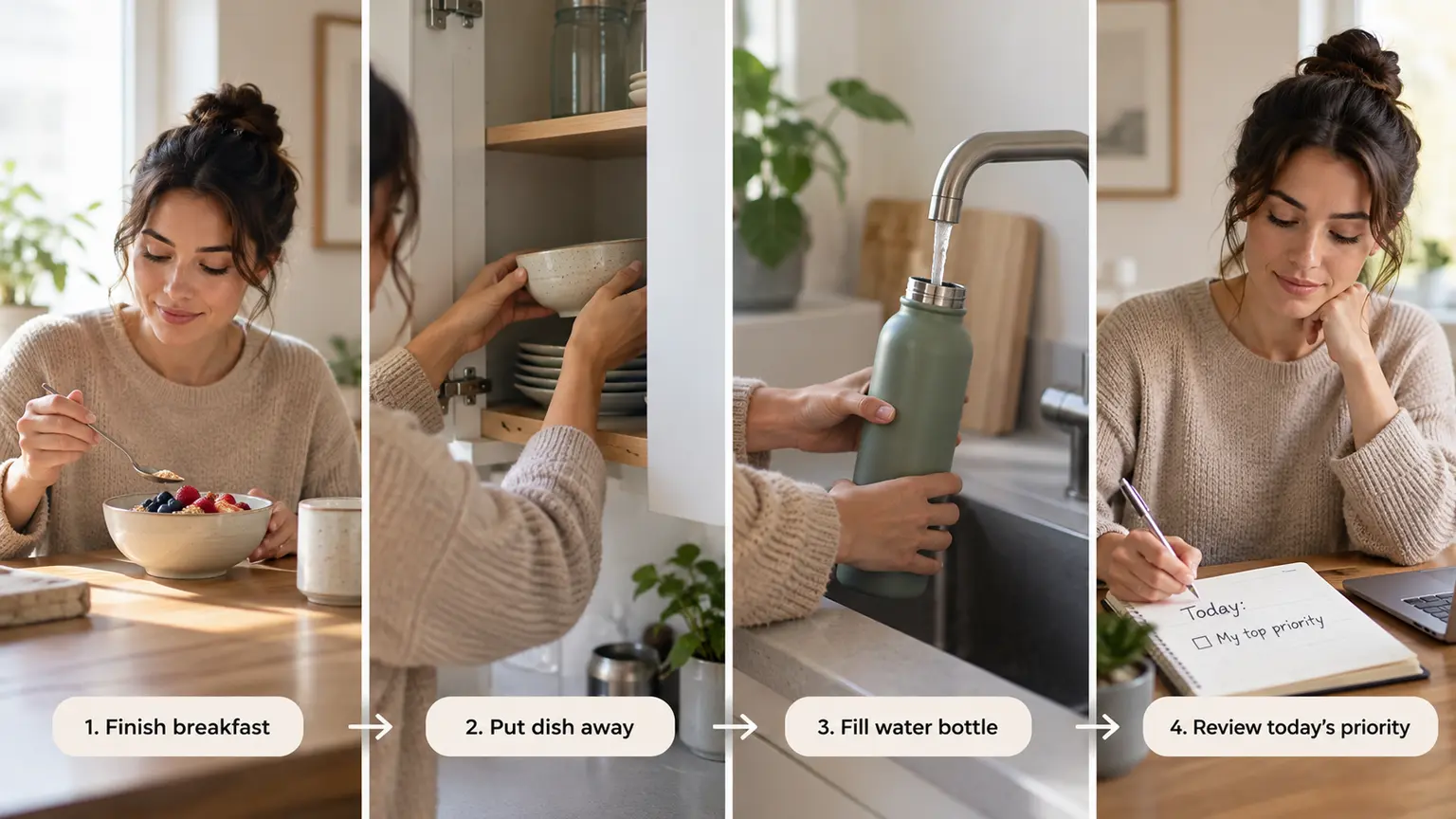
A routine might say: breakfast, plan, exercise, shower. A stack specifies the transition: after setting down the breakfast bowl, open the notebook and write today's priority. You can have a routine without these explicit connections.
The new behavior also does not become a habit merely because it appears in the formula. At first you may need a note or reminder. Treat the stack as an arrangement for practice, then observe whether starting becomes easier.
Our self-improvement habits guide explains how to place one stack inside a broader daily routine without scheduling every available minute.
Choose an anchor that survives an ordinary day

List things you already do at the frequency you need. Good candidates have a clear finishing moment: locking your front door, putting your plate away or closing a work document. “During the morning” is a period, not an anchor.
Test four details before choosing:
- Occurrence: does the anchor happen on the days you want the new behavior?
- Noticeability: can you identify the moment without checking a clock repeatedly?
- Location: are the required materials within reach?
- Capacity: do you have the attention, time and physical ability for the next action?
An anchor can be reliable and still unsuitable. Brushing your teeth happens regularly, but the bathroom may be a poor place to practice an instrument. Arriving home may happen daily, but it may coincide with urgent care responsibilities. Choose the available moment, not simply the most frequent action.
Observe a few opportunities if you are unsure. If you drink coffee only on quiet weekends, it is not a daily anchor. If you finish work at varying times but always close your task document, the event may be more reliable than a 5 p.m. reminder.
How small should the new action be?
Start with a version you can describe in one sentence and complete without elaborate preparation. One practice question, one sentence, one item put away or a short comfortable movement can be enough to test the connection.
Small does not mean meaningless. If the aim is learning, opening the notes prepares for practice; answering a question performs practice. Both can be steps, but record which one you actually completed. Otherwise you may build a dependable ritual that never reaches the activity you care about.
Set a normal version and a minimum version when useful. After opening the study notebook, you might normally work for ten minutes and do one question on a compressed day. Define the stop so the minimum does not secretly require continuing.
24 habit stacking examples by context
These are hypothetical designs to adapt, not a recommendation to adopt all 24. Select one whose cue already happens in your life. Change the action if the location, accessibility or available time does not fit.
Morning
| Existing action | New action | Practical detail |
|---|---|---|
| After I put my breakfast dish away | I write today's first priority | Keep one notepad where you finish breakfast |
| After I collect my keys | I check the one essential item I often forget | Use a short list, not a complete life inventory |
| After I finish getting dressed | I review one language flashcard | Prepare the card beforehand; avoid opening a feed |
The first illustration shows several possible transitions. For a beginner, choose one. Our morning routine guide helps decide which activity deserves the available time.
Evening
| Existing action | New action | Practical detail |
|---|---|---|
| After I close the final work document | I note the next starting step | Save the note beside the project |
| After I finish dinner cleanup | I put tomorrow's bag by the door | Prepare only items actually needed |
| After I set my alarm | I place the phone at its charging spot | Preserve emergency access if necessary |
Choose an earlier cue if the last part of the evening is unpredictable. The evening reset guide includes routines that can be divided across the evening.
Studying and learning
| Existing action | New action | Practical detail |
|---|---|---|
| After I sit at my usual study desk | I write the question for this session | Make it narrow enough to answer |
| After I finish a section of notes | I explain one idea without looking | Then check for a missing step |
| After I put away the textbook | I mark the next problem to attempt | Reduce setup at the next session |
Work and productivity

| Existing action | New action | Practical detail |
|---|---|---|
| After I join a scheduled meeting | I write the decision the meeting needs | Adapt to your role and meeting purpose |
| After I send a deliverable | I record its next follow-up date | Only when a follow-up is actually required |
| After I return from lunch | I open the task chosen before the break | Keep the first action visible |
Fitness and wellbeing
| Existing action | New action | Practical detail |
|---|---|---|
| After I finish a seated work block | I change position comfortably | Use movement appropriate to your mobility |
| After I put lunch away | I take a short walk or an accessible alternative | Choose a safe route and realistic duration |
| After I return from planned exercise | I put equipment ready for its next use | Do not let cleanup become a second workout |
Relationships
| Existing action | New action | Practical detail |
|---|---|---|
| After I greet someone at home | I ask one question and listen to the answer | Check whether it is a welcome moment |
| After a friend mentions an important date | I record it with their permission where appropriate | Avoid collecting sensitive details unnecessarily |
| After our recurring family meal | I ask whether anyone needs practical help tomorrow | Keep it a conversation, not a performance review |
Personal growth
| Existing action | New action | Practical detail |
|---|---|---|
| After I close my journal | I circle one action worth testing | Leave the rest as reflection |
| After I complete a difficult task | I note what made starting easier | Build a record of useful conditions |
| After my weekly calendar review | I remove one commitment that no longer fits | Renegotiate responsibilities rather than silently dropping them |
Digital habits
| Existing action | New action | Practical detail |
|---|---|---|
| After I check a necessary message | I close the app instead of opening its feed | Give the check a defined purpose |
| After I download a needed file | I place it in the relevant folder | Name it so you can find it later |
| After I finish an online purchase | I close the shopping tabs | Keep receipts without continuing to browse |
Design your first stack in six steps
Choose the purpose. Identify what the action should improve. “Remember the next project step” is more useful than “be disciplined.”
Observe the anchor. Notice when and where it actually occurs. Write down interruptions rather than assuming they will disappear.
Define the minimum action. Make it useful, short and possible at the cue. If it needs setup, prepare beforehand or choose another cue.
Place a temporary reminder. A note near the anchor can support the first attempts. Avoid adding reminders everywhere until none attracts attention.
Rehearse once. Walk through the sequence and check for physical obstacles. The exercise often reveals that the notebook is in the wrong room or the “quick” task requires logging into several systems.
Review actual opportunities. Record whether the cue occurred and whether you acted. Change one design element at a time so you can tell what helped.
Weak stacks versus better stacks
| Weak stack | Why it is weak | Better version |
|---|---|---|
| After I wake, I improve my life | No observable response | After dressing, I answer one prepared revision question |
| After coffee, I do an hour of exercise | May exceed the available window | After putting the mug away, I begin the short movement session I planned |
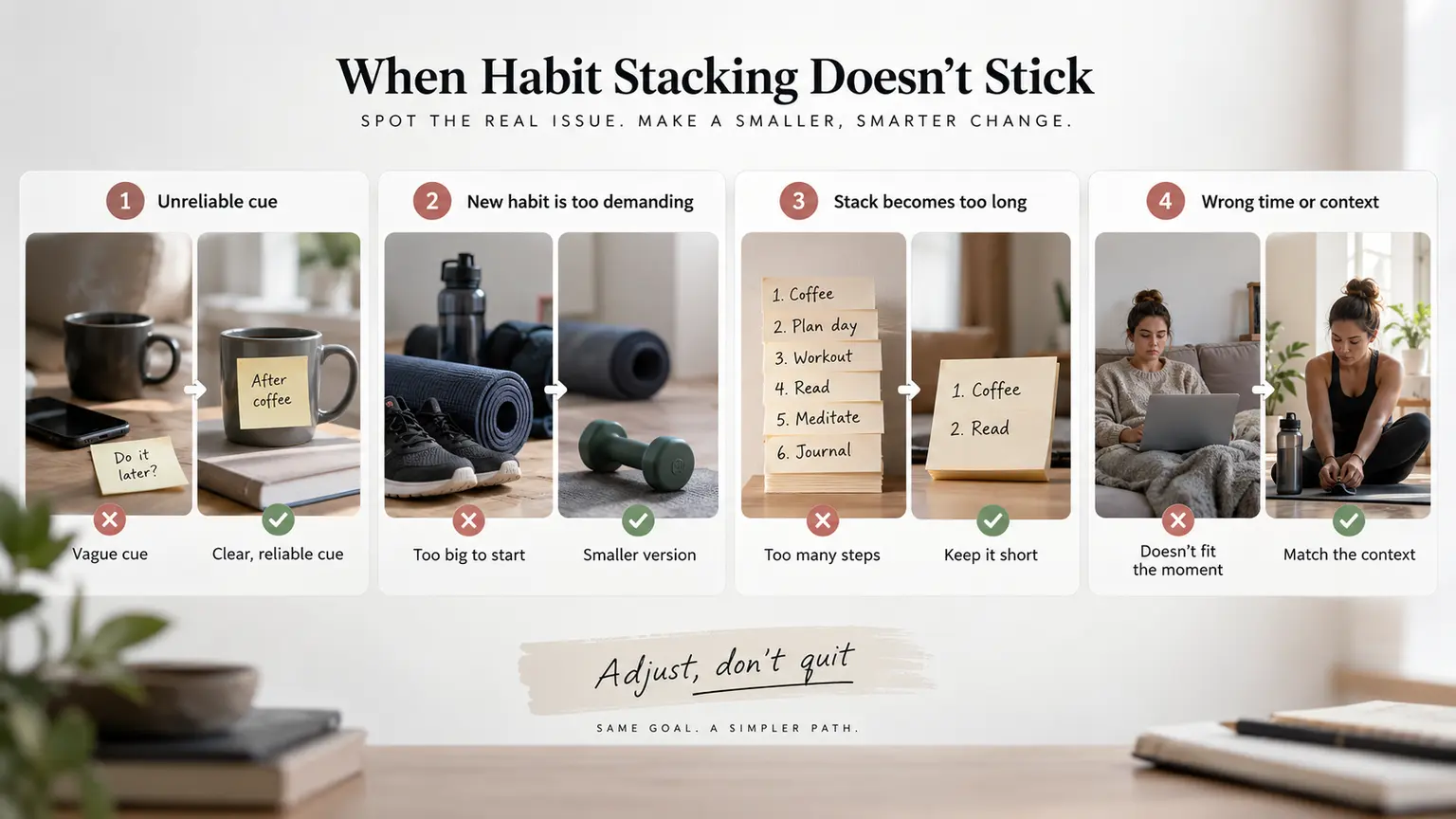
| After I meditate, I journal | Anchor is also a new, unreliable behavior | After an established evening task, I write one sentence |
| After lunch, I plan, read, exercise and clean | Several new demands depend on one transition | After lunch, I choose the first afternoon task |
Troubleshooting a stack that fails
| Problem | Likely reason | Fix to test |
|---|---|---|
| I never remember | Anchor is broad or unnoticed | Name its exact ending and add a temporary visible cue |
| I notice but avoid it | Action is too demanding or unclear | Reduce to one useful action with a clear stop |
| It works only on weekends | Anchor changes across the week | Create a separate weekday cue or change the frequency |
| I get interrupted halfway | The moment is not protected | Use an interruption-tolerant action or move it |
| One miss collapses the chain | Too many actions depend on each other | Return to one anchor and one new behavior |
| I do it but it does not help | Behavior is poorly matched to the goal | Reconsider the action instead of extending the streak |
If the old response still wins, look at what it provides. A news feed may offer a break your new task does not. You may need to plan a real break as well as change the cue. See how to replace an unwanted habit.
Common beginner mistakes
Do not use another hoped-for habit as the foundation. Establish one connection before depending on it. Do not treat a naturally weekly anchor as a failed daily anchor. Do not turn every moment into a productivity trigger; some transitions can remain unplanned.
Also avoid expanding a stack after every successful day. A routine should earn more space through usefulness and fit, not through enthusiasm alone. The Atomic Habits analysis discusses why small starts still need a sensible progression toward the real goal.
A seven-day habit-stacking experiment
Day 1: List three existing anchors and choose the most suitable one.
Day 2: Define the new action and its minimum version. Put materials in place.
Day 3: Try the connection at the real cue. Record what interrupted or delayed it.
Day 4: Repeat without adding another action. Notice whether the anchor is obvious.
Day 5: Change one obstacle if needed. Keep the purpose constant while testing the design.
Day 6: Write a fallback for a missed cue. If there is no appropriate later opportunity, resume at the next normal occurrence.
Day 7: Review the opportunities, completions and usefulness. Decide whether to keep, move, shrink or replace the stack.
This is not a seven-day habit-formation claim. Lally and colleagues' study found wide variation in the time associated with increasing automaticity.
Copy this template
“After I ______ at/in ______, I will ______. My minimum useful version is ______. The materials will be ______. If the anchor does not occur, I will ______. I will review whether this helps on ______.”
For example: “After I close the lunch container at my desk, I will open the afternoon task note. My minimum useful version is reading its first action. The note will be pinned in the project folder. If lunch happens elsewhere, I will use returning to the desk as my cue. I will review on Friday.”
Frequently asked questions
How many habits should I stack?
Start with one new behavior attached to one reliable action. Add another only if the sequence fits and has proved useful. There is no universal best chain length.
Does habit stacking work with an irregular schedule?
It can be practical when the cue is an event that recurs despite changing hours. Check that the event leaves the right time and setting for the new action. Frequency may need to vary with your schedule.
What if I forget the new behavior?
Check whether you noticed the anchor. Make it more specific or add a reminder at the point of action. If you remembered but avoided the behavior, the issue is probably size, clarity or fit rather than memory alone.
Can I use stacking to break a bad habit?
You can connect a useful alternative to a recurring cue, but also examine the old behavior's function and environment. A formula alone may not address the reason the old response keeps returning.
Choose one example and make it yours
Use the tables to find a relevant context, then rewrite the cue and action for your own day. A useful habit stack has a place, a start and a finish. Test that connection before trying to build an entire routine from it.