

A night routine for personal growth is a short sequence that helps you finish practical tasks, learn something useful from the day and prepare to rest. It can be as simple as writing tomorrow's first action, putting one essential item in place and choosing a quiet activity. Its value comes from solving a problem, not from completing an impressive list.
If evenings feel scattered, begin by identifying what keeps them open-ended. Is unfinished work following you into the bedroom? Are you remembering tomorrow's tasks while trying to read? Does checking one message turn into an hour of scrolling? Each problem needs a slightly different boundary.
The suggestions below are behavior-design tools, not treatment for sleep problems. Use them alongside the broader self-improvement habits guide to build a daily routine with room for real life.
What an evening reset can and cannot accomplish
An evening reset gives unfinished tasks a place to wait. Preparing a bag removes a morning search; identifying the next work step removes a decision. Those are modest, concrete benefits you can evaluate without promising a transformed life.
A routine does not require you to resolve every worry or feel peaceful on command. Some days end with uncertainty. You can close the notebook while still caring about a problem. Closure means deciding where you will return to it, not declaring it solved.
Sleep matters for attention and memory, and the CDC recommends regular sleep timing and reducing electronic-device use before bed. This does not mean a specific evening ritual will make everyone sleep well. Persistent sleep difficulty calls for appropriate advice beyond a general routine article.
Design the routine around your most difficult transition
Pick one transition: work to personal time, household duties to rest, or screen entertainment to bed. Do not expect a single ten-minute routine to fix all three immediately.
Then select a cue that happens reliably. Closing your work laptop is a good candidate only if you actually finish work in one place. If you keep reopening it, the first problem may be an unclear work boundary. After the final dinner cleanup could be a better starting point for household preparation.
Write a small agreement with yourself: “After I put away the last plate, I will check tomorrow's first commitment.” If events work better than clock times for your schedule, use them. Our habit stacking guide explains how to test whether an anchor is reliable.
Separate planning from relaxation if they need different times. You might close work at 6 p.m., prepare a bag after dinner and read shortly before bed. An evening routine does not have to be one uninterrupted performance.
Close the day without reopening it
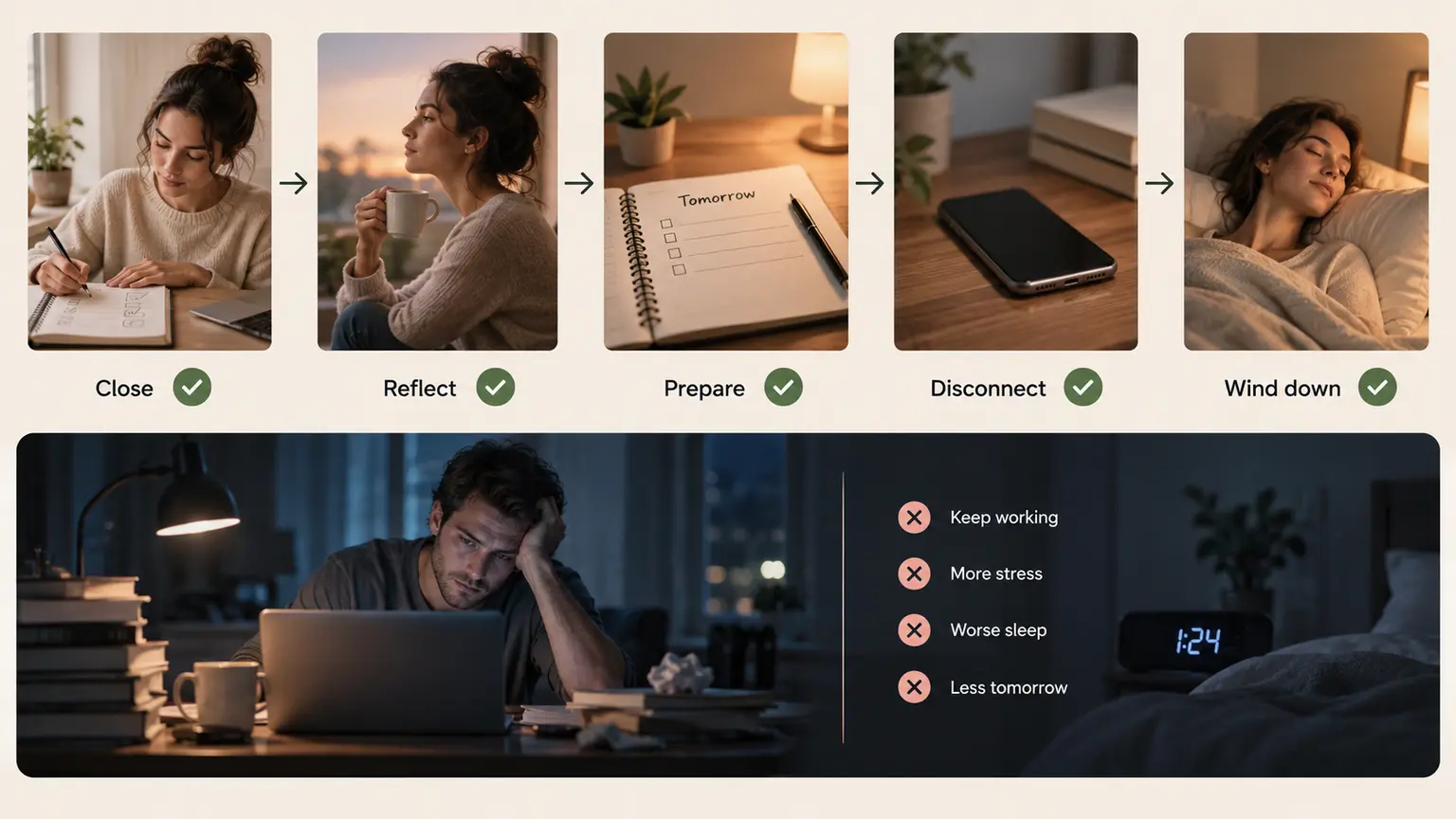
Create a short closing note with three parts: what is unfinished, the next action, and when you will revisit it. “Proposal unfinished; draft the price comparison after the morning meeting” gives the task a future home. “Must sort everything out” does not.
For a household task, the next action might be checking the school message or putting the appointment card beside your bag. Capture enough detail that tomorrow's version of you will understand. Do not write a complete project plan at bedtime.
If a new idea arrives after you stop, add one line to the same place. Avoid opening the whole work system unless the matter genuinely cannot wait. A capture note is a parking place, not permission to start another session.
If you work with others, practical closure may require an explicit handoff. Use existing workplace expectations for urgent contact. A personal ritual cannot settle responsibilities that have never been clarified.
Reflect without turning the evening into a trial
Try three short prompts: What happened? What helped or got in the way? What is one adjustment worth trying? Keep the focus on an event you can describe rather than a judgment about your character.
For example: “I moved between tasks when the report became unclear. Asking which decision the report needs to support might help tomorrow.” That is more actionable than writing several paragraphs about being undisciplined.
Give the review a limit, such as three minutes or three sentences. If you begin repeating the same conclusion without learning anything new, stop the exercise and schedule problem-solving for another time. The purpose is to extract a useful observation, not to exhaust the topic.
Gratitude can be included if it feels meaningful. It is optional, and it should not require pretending a difficult day was good. “A colleague explained the confusing part” is sufficient; there is no obligation to produce a profound insight.
Prepare tomorrow's first action, not tomorrow's entire life
Choose one priority that fits the real calendar, including travel, meetings and care duties. Define a first action you could begin without another planning session. “Open the draft and write three bullet points” is clearer than “make progress.”
Then prepare one relevant item: the document, a bag, an ingredient or the appointment address. Resist adding a complete household reset if the original problem was simply forgetting one thing. A useful routine should not expand every night.
There is limited evidence for bedtime task writing: in a small laboratory study of healthy young adults, participants writing future tasks fell asleep sooner than those writing completed activities. The study does not prove that all journaling improves sleep or that this treats insomnia.
If planning makes you more alert or worried, move it earlier. You can leave the final part of the evening for something that does not involve solving tomorrow. The morning routine guide shows how to use that prepared starting point.
Journaling, reading and relaxation: choose by function
Journaling is useful when you want a record or a clearer description of something. Choose a narrow prompt and keep the notebook private in whatever way fits your household. The mistake is treating every evening as an invitation to analyze your whole life.
Reading can be a pleasant transition when the material suits the moment. A familiar novel, essay or audiobook may fit better than a difficult professional text. There is no requirement to finish a chapter. If the book makes you want to research ten new subjects, save it for another time.
Relaxation can be quiet music, a comfortable stretch, an unhurried shower or simply sitting without another task. Adapt movement to your needs and stop if uncomfortable. These are activity options, not guaranteed physiological techniques.
Pick the option that serves tonight's need. If you are tired, preparing for bed may be more useful than insisting on a reading goal. If you want connection, a welcome conversation may matter more than solitary reflection.
Make digital boundaries specific enough to use

“Use my phone less” leaves every decision open. Define the activity and boundary: “After my final message check, I will charge the phone on the shelf and read until I am ready for bed.” Keep emergency or care-related contact available if you need it.
Decide what entertainment you actually want. Watching a chosen episode is different from continuing because another one starts automatically. You might disable autoplay, choose a stopping point before you begin or remove a particularly distracting app from the home screen.
The screen is only one part of the problem. Urgent work, upsetting news and absorbing games can also keep the evening active. Changing display settings does not make an unlimited work session a wind-down activity.
If you rely on your phone for an alarm, reading or accessibility, create a narrow use mode rather than an unrealistic total ban. Download the audio, silence nonessential notifications and keep the required function easy to reach. For a persistent pattern, use our guide to changing unwanted habits.
How long should an evening routine take?
Long enough to handle the problem; short enough that it does not delay rest. The examples below are allocations to adapt, not a ranking. Essential personal care may need additional time. If so, shorten the optional activities rather than rush care or push bedtime later.

A 10-minute minimalist routine
Spend two minutes capturing unfinished tasks, two choosing tomorrow's first action, two preparing one item, and four beginning personal care or a quiet transition.
This works as a brief reset after an unexpectedly long day. For example, a student notes which assignment section comes next, checks the first class time, packs the right notebook and puts the phone aside. If even ten minutes is unavailable, capture the essential task and finish necessary care.
A 30-minute routine
Use five minutes for closure, five for practical preparation, five for personal care, and fifteen for reading or another quiet activity. Move reflection into the closure block rather than adding a separate exercise.
For someone working from home, closure might happen at the desk while reading happens elsewhere. If the first ten minutes regularly grow into cleaning or email, define the precise task in advance and stop when it is done.
A 60-minute routine
Allow ten minutes for finishing practical tasks, ten for review and tomorrow's plan, fifteen for personal care, twenty for a chosen restful activity, and five for the final transition to bed.
Choose this version only when it fits. The extra time can support enjoyment, not more self-assessment. A long social evening may replace part of it, and a tired evening may call for the minimalist option instead.
Adaptations for different responsibilities
Busy people and parents
Use a divided routine. Prepare one essential item while already finishing household duties; do a short closure note when a window appears; leave only basic care and rest for the final part of the night. Do not assume uninterrupted silence.
If another adult shares responsibility, agree on what needs doing and what can wait. “Reset the house” is vague enough to become endless. “Put tomorrow's bags beside the door” has a finish line.
Students
Record the next study action before closing your materials. Check the next day's schedule once, then pack. If you want to reflect, note what you did not understand and where you can ask for help.
Avoid treating late-night rereading as a compulsory ritual. If you are using the routine to postpone ending a difficult study session, move the academic review earlier and give the evening a clearer stopping point.
People working from home
Put work equipment out of sight where possible, or cover and close it when space is shared. Write the next task before shutting down. If the dining table must become a desk again tomorrow, keep materials in one container rather than spread across the room.
The point is a visible transition, not a perfectly separate office. If your job requires evening availability, define which channel and which period actually require attention, then protect what remains.
What to do after a missed evening
Resume at the next useful cue. Do not double tomorrow's reflection time or complete two evenings' checklists. If you missed preparation and the morning becomes rushed, do the necessary task and use that information for the next plan.
Separate a lapse from abandoning the plan. A lapse is one missed opportunity; abandonment is deciding there is no next attempt. You can keep the plan alive by naming the next cue, even after several difficult nights.
Repeated misses are information. If the cue happens after you are already exhausted, move it earlier. If preparation takes twenty minutes rather than five, choose fewer items. If the evening is your only personal time, preserve some enjoyment rather than removing everything you look forward to.
A seven-day evening reset
Day 1: Observe the point where the evening becomes open-ended.
Day 2: Write one closing note with a next action and a return time.
Day 3: Prepare one item that tomorrow genuinely needs.
Day 4: Try a three-sentence review; stop if it becomes repetitive.
Day 5: Set one digital boundary that preserves necessary contact.
Day 6: Choose a quiet activity and a realistic stopping point.
Day 7: Keep what helped, remove what became another burden and write a minimum version for busy nights.
This tests the design, not whether you have established an automatic habit. Repetition in a recurring context is part of habit development; a one-week challenge is only a beginning.
A checklist to save
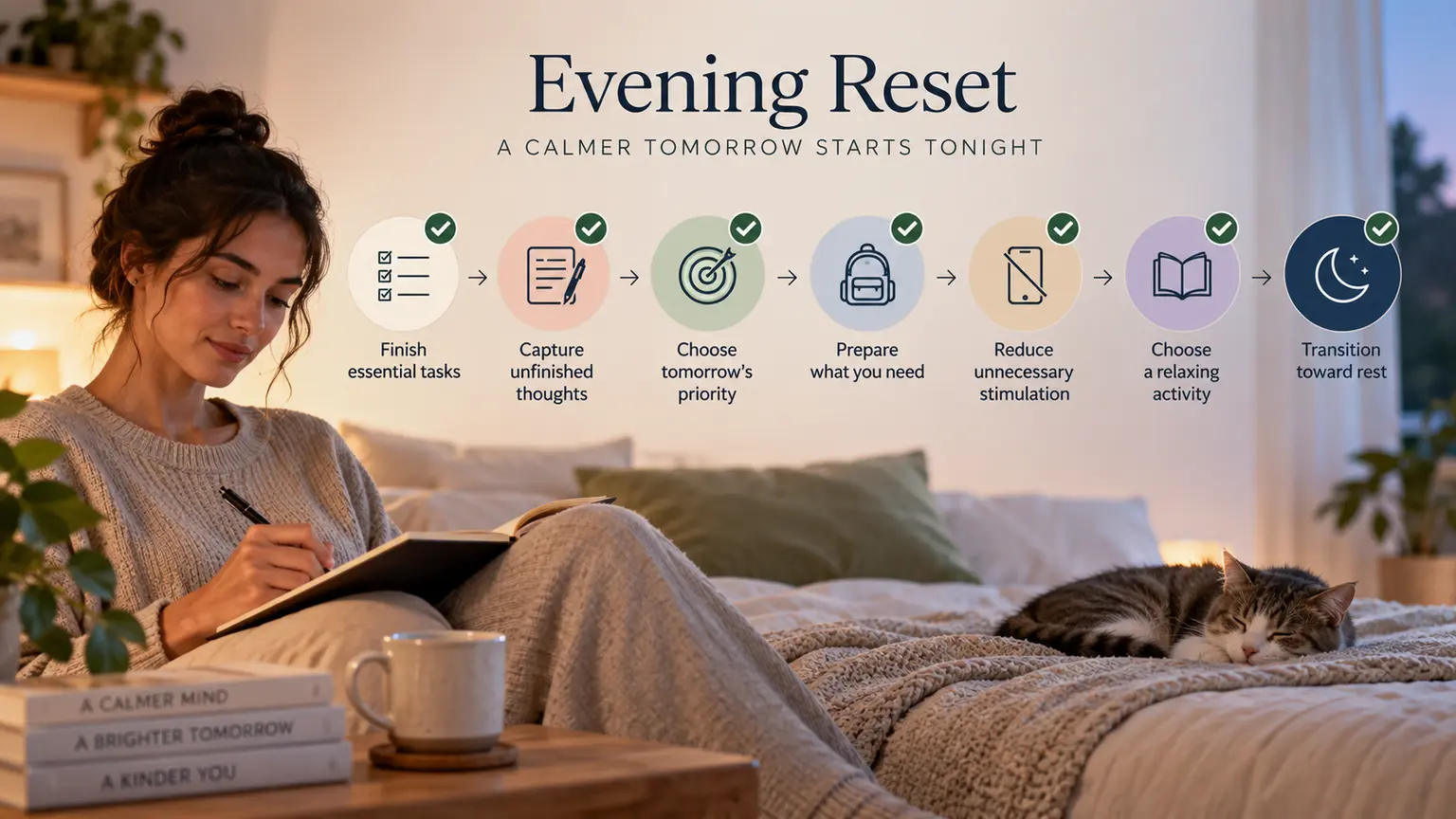
- Essential tasks are finished or deliberately scheduled.
- Unfinished thoughts have one place to wait.
- Tomorrow has a first action.
- One needed item is prepared.
- Nonessential digital activity has a stopping point.
- I have chosen rest rather than another open-ended assignment.
Frequently asked questions
What is a good night routine for personal growth?
A useful routine combines a short review, a practical step for tomorrow and a transition toward rest. Choose only the parts that solve your evening's actual problem. Ten minutes can be a reasonable starting experiment.
Should I journal every night?
Only if it serves a purpose. A single useful note may be enough. If journaling repeatedly becomes self-criticism or prolonged worry, change the prompt, move it earlier or leave it out.
Can I watch television in an evening routine?
Yes, if it is an activity you choose and it fits your intended stopping time. Set a boundary around duration and notice whether the content helps you wind down or keeps you engaged beyond your plans.
What if I work nights?
Use the routine before your main sleep period, whatever the clock time. Separate work closure from other household demands as far as your circumstances allow. You do not need an evening aesthetic for the sequence to be useful.
Give the day a place to end
Tonight, capture one unfinished task, prepare one useful item and choose what happens after the final screen check. Your night routine for personal growth should make tomorrow easier while leaving tonight enough room to end.