
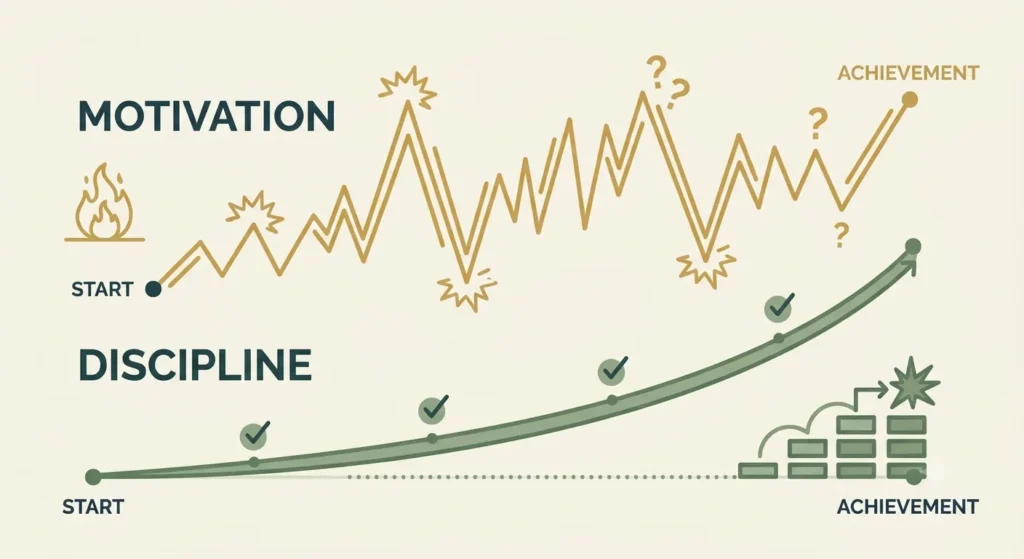
Motivation gets all the attention, the pump up videos, the inspiring quotes, the burst of energy on January first. But motivation is also the first thing to disappear the moment life gets busy, stressful, or simply boring. Discipline is what shows up after motivation leaves the room.
This guide breaks down the real difference between the two, why relying on motivation quietly sabotages most habit attempts, and how to build the kind of discipline that does not require you to feel like it every day.
What motivation actually is
Motivation is an emotional state, a temporary surge of energy or desire that makes an action feel exciting or urgent. It is triggered by things like a new goal, a deadline, an inspiring story, or even just a good night of sleep. The problem is that emotional states are, by definition, unstable. They rise and fall based on factors you often cannot control.
What discipline actually is
Discipline is the ability to follow through on an intended action regardless of how you feel in the moment. It does not require excitement or inspiration, only a decision made in advance and a system that makes following through easier than skipping.
Where motivation asks how do I feel right now, discipline asks what did I already decide to do. That single shift removes the daily negotiation that quietly kills most habits within the first few weeks.
Why motivation alone cannot build lasting habits
Motivation naturally fades as a behavior becomes routine, which is exactly the moment most habits are still fragile. Research on behavior change consistently shows that relying on emotional highs to sustain a new habit leads to inconsistent effort, since the habit only happens on days the feeling shows up.
This is why so many people start strong in January and quietly stop by February. The motivation that launched the habit was never designed to sustain it for months.
Why discipline outperforms motivation over time
Discipline works because it removes the daily decision entirely. Once a behavior is treated as non negotiable rather than optional, whether you feel like doing it stops being part of the equation. This is the same principle behind brushing your teeth, most people do not feel motivated to do it, they simply do it because it is decided.
The habits that last the longest are almost always the ones that stopped depending on how the person felt that day.
How to build discipline without relying on motivation
Start smaller than feels necessary
A habit so small it feels almost pointless, one pushup, one sentence, one page, is far easier to complete on a low motivation day than an ambitious version of the same habit.
Remove the daily decision
Decide the time, place, and trigger for the habit in advance, so there is nothing left to negotiate with yourself in the moment.
Use identity instead of willpower
Rather than trying to feel motivated, tell yourself simply I am someone who does this. Identity based habits tend to survive low motivation days that pure willpower cannot.
Expect and plan for low motivation days
Build a smaller backup version of the habit for your worst days, so missing the full version does not turn into missing it entirely.
Real life example: how tarek stayed consistent without motivation
Tarek, a 36 year old sales manager, used to rely entirely on motivation to hit the gym, which meant he trained hard for two or three weeks after every new goal, then stopped completely once the initial excitement faded. This cycle repeated for years.
The shift happened when he stopped trying to feel motivated and instead scheduled his gym time exactly like a work meeting, non negotiable, same time, same days, regardless of mood. On low energy days, he allowed himself a shortened fifteen minute version instead of skipping entirely. A year later, he had trained consistently through busy work periods, low motivation stretches, and even a minor injury, something no previous motivation driven attempt had survived past six weeks.
your discipline building plan
- Step 1: Choose one habit and decide its time, place, and trigger in advance, removing daily decision making.
- Step 2: Create a shrunk down backup version of the habit for low motivation or low energy days.
- Step 3: Replace the question do I feel like it with a simple identity statement, such as I am someone who does this.
- Step 4: Track completions for three weeks, treating the habit as non negotiable regardless of mood.
Common mistakes people make with motivation and discipline
- Waiting to feel motivated before starting a habit instead of starting regardless of mood
- Setting a version of the habit too ambitious to survive a low energy day
- Treating a lack of motivation as a sign the habit or goal is wrong
- Relying on inspiration content instead of building a system that does not require it
Discipline is one piece of the larger habit formation picture. The complete guide to self-improvement habits covers how habits form and how long they typically take to become automatic.
The identity based approach described above draws directly on the identity habits concept covered in the atomic habits summary, which explains why identity tends to outlast motivation.
For a closer look at how consistent, disciplined systems show up in daily work life, the guide on productivity habits of highly successful people breaks down several real examples.
Recommended resources
A couple of tools help remove the daily decision making described in this guide:
Useful for tracking completions without relying on memory or motivation to remember the habit happened.
Helps schedule the habit’s time and trigger in advance, removing the daily negotiation discussed above.
Frequently asked questions
is motivation ever useful for building habits
Yes, motivation is genuinely useful for starting a new habit, but it should not be relied on to sustain it past the first few weeks, since discipline and systems are what carry a habit through low motivation periods.
can discipline be built like a skill
Yes. Discipline tends to strengthen with practice, particularly when you consistently follow through on small commitments, even ones that feel unimportant.
why do I feel motivated some days and not others
Motivation is influenced by sleep, stress, and even blood sugar, which is exactly why it is an unreliable foundation for a habit meant to last months or years.
what is the fastest way to build discipline
Start with a habit small enough that skipping it feels more effortful than doing it, then keep the time and trigger identical every day.
does discipline mean ignoring how I feel entirely
No. It means not letting how you feel be the deciding factor for whether you follow through, while still adjusting the size or intensity of the habit on genuinely difficult days.
can too much discipline become unhealthy
Rigid, all or nothing discipline that ignores rest, illness, or genuine limits can become counterproductive. Sustainable discipline includes planned flexibility, not constant force.
is willpower the same thing as discipline
They are related but not identical. Willpower is the mental effort of resisting temptation in a single moment, while discipline is the broader habit of following through consistently over time.
Motivation will always come and go, and building a habit around it means the habit comes and goes too. Discipline succeeds because it removes that dependency entirely, replacing daily feelings with a decision you already made. Start small, remove the daily negotiation, and let consistency do the rest.