
Most new habits fail for a simple reason. They depend on remembering to do them and feeling motivated enough to follow through, and both of those run out fast. Habit stacking solves this by removing the guesswork entirely. Instead of hoping you remember, you attach the new habit to something you already do every day without thinking.
This guide walks through exactly how habit stacking works, with real examples you can copy today, plus the mistakes that quietly stop most people from making it stick.
what is habit stacking
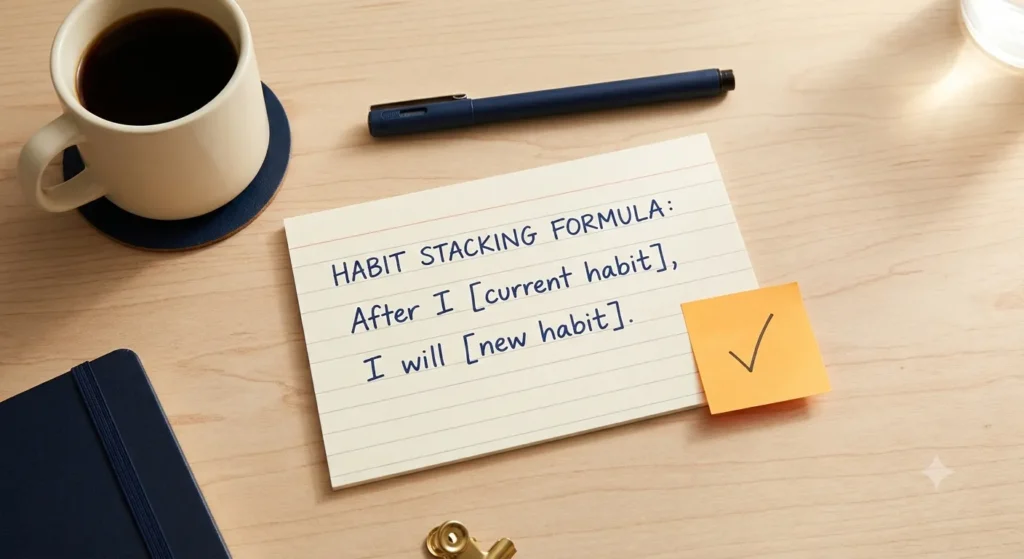
Habit stacking is a method where you pair a new habit with an existing one, using the existing habit as a built in reminder. The formula is simple. After I do this current habit, I will do this new habit. Because the trigger is something you already do automatically, you no longer need willpower or memory to start the new behavior.
why habit stacking works so well
Your brain already has thousands of automatic routines wired in, brushing your teeth, making coffee, sitting down at your desk. Habit stacking borrows the strength of those existing neural pathways instead of trying to build a brand new trigger from scratch. That is why it tends to succeed where willpower alone usually fails.
the habit stacking formula
- Pick one habit you already do consistently, every single day, without fail
- Choose a new habit that is small enough to finish in under two minutes at first
- Write the pairing as a simple sentence: after I finish current habit, I will do new habit
- Keep the pairing exactly the same for at least three weeks before adjusting anything
ten habit stacking examples you can copy today
- After I pour my morning coffee, I will write down my top priority for the day
- After I sit down at my desk, I will take three slow breaths before opening my laptop
- After I brush my teeth at night, I will lay out my clothes for tomorrow
- After I close my laptop at the end of work, I will write one sentence about how the day went
- After I start the coffee maker, I will do two minutes of stretching while it brews
- After I sit down on the train or bus, I will read five pages of a book
- After I finish lunch, I will take a five minute walk before returning to my desk
- After I plug in my phone to charge at night, I will place a book on my pillow
- After I turn off my alarm, I will drink a full glass of water before checking my phone
- After I get into bed, I will write down three things that went well that day
real life example: how marcus finally started exercising
Marcus, a 38 year old accountant, had tried to start exercising for years, joining gyms, buying equipment, and setting alarms for early workouts that he almost never followed through on. Nothing stuck for more than two weeks.
The shift happened when he stopped trying to build exercise as a standalone habit and instead attached it to something he already did without fail: brushing his teeth in the morning. His new rule was simple. After I brush my teeth, I will do ten push ups. Because it took under a minute and had a built in trigger, he rarely skipped it. Six months later, the ten push ups had grown into a full fifteen minute routine, without him ever forcing a dramatic change.
your habit stacking starter plan
- Step 1: List five habits you already do every single day without exception.
- Step 2: Choose one of those habits as your anchor for a new habit you want to build.
- Step 3: Write your stacking sentence and place a visible reminder near where the anchor habit happens.
- Step 4: Track it for three weeks before adding a second stacked habit.
common mistakes that break a habit stack
- Choosing an anchor habit that is not actually consistent, such as gym visits or weekend routines
- Stacking a new habit that takes too long, which makes it easy to skip on busy days
- Adding three or four new habits onto the same anchor at once instead of one at a time
- Changing the order or the anchor habit too soon, before the new pairing feels automatic
Habit stacking is one tool inside a bigger system. For the full framework on how habits form and how long they typically take to stick, the complete guide to self-improvement habits covers the underlying principles behind this method.
Many of the stacking examples above work especially well at night. The evening routine ideas guide shows a full sequence built entirely from stacked habits.
If you want more examples of tiny habits worth stacking, the guide on small habits that create big life changes goes deeper into why size matters more than intensity.
recommended resources
A few simple tools make habit stacking easier to track in the first few weeks:
Useful for writing your stacking sentence and placing it exactly where the anchor habit happens.
Gives you one place to mark whether the stacked pairing happened each day for the first three weeks.
frequently asked questions
what makes a good anchor habit for stacking
Something you already do every single day without exception, such as brushing your teeth, making coffee, or sitting down at your desk.
how many habits can I stack onto one anchor
Start with just one. Once that pairing feels automatic, usually after three to four weeks, you can add a second habit onto the same anchor.
what if I miss the anchor habit itself for a day
The stacked habit will likely be missed too. This is normal and does not undo your progress, simply resume the pairing the next time the anchor habit happens.
can habit stacking work for bigger goals like exercise
Yes, as long as the stacked version starts extremely small, such as two minutes, rather than a full workout. The habit can grow naturally once it becomes automatic.
is habit stacking the same as a routine
A routine is usually several habits performed together in sequence. Habit stacking is the method used to build each individual link in that chain.
how long before a stacked habit feels automatic
Most people notice it becoming automatic somewhere between three and eight weeks, though this varies depending on the complexity of the new habit.
should I tell other people about my habit stack
It is optional, but sharing your plan with someone else can add light accountability, which some people find helpful in the first few weeks.
conclusion
Habit stacking works because it removes the two biggest reasons new habits fail, forgetting and relying on motivation. Pick one anchor habit you already do without fail, attach one small new habit to it, and give the pairing a few weeks before judging whether it worked. That is the entire method.