
Some people seem to navigate conflict, stress, and difficult conversations with a kind of ease that has nothing to do with intelligence in the traditional sense. They are not necessarily the smartest person in the room, but they read situations accurately, manage their own reactions, and connect with people in a way that consistently works in their favor. That ability has a name, emotional intelligence, and unlike raw IQ, it can actually be developed.
This guide covers what emotional intelligence really means, the five components that make it up, how it differs from IQ, and where to start if you want to build it starting today.
What emotional intelligence actually means
Emotional intelligence, often shortened to EQ, is the ability to recognize, understand, and manage your own emotions, while also recognizing and responding effectively to the emotions of other people. It is not about suppressing emotions or being endlessly agreeable, it is about having enough awareness and control that emotions inform your decisions instead of hijacking them.
The concept was popularized in the 1990s, building on decades of psychological research showing that traditional intelligence tests failed to predict real world success nearly as well as people assumed.
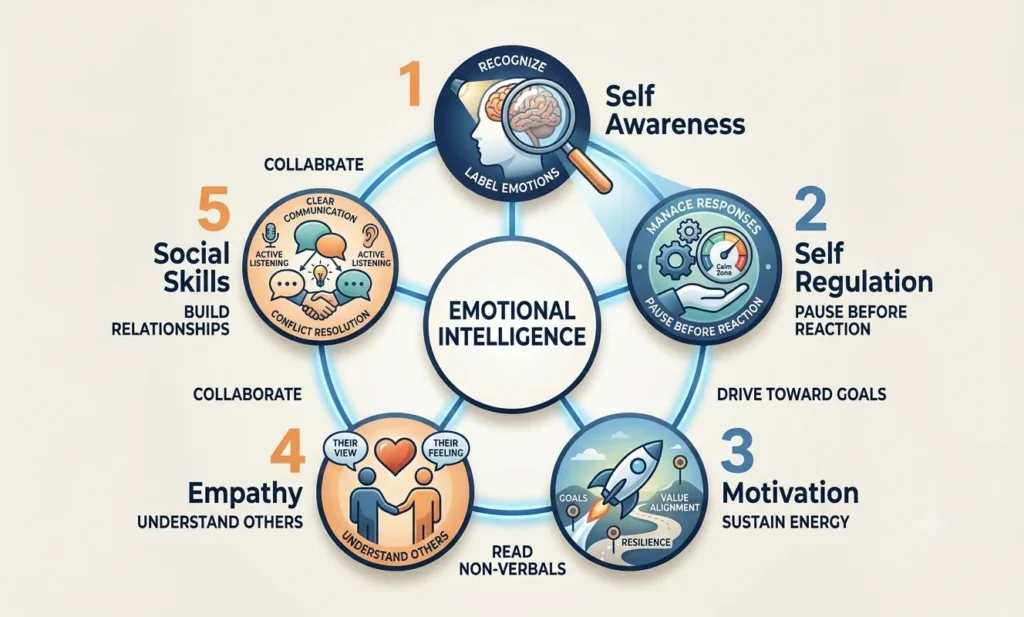
The five components of emotional intelligence
Self awareness
The ability to accurately recognize your own emotions as they happen, along with understanding how those emotions influence your thoughts and behavior.
Self regulation
The ability to manage disruptive emotions and impulses, staying composed and thoughtful rather than reacting on autopilot.
Motivation
An internal drive to pursue goals for reasons beyond external reward, paired with resilience when setbacks happen along the way.
Empathy
The ability to sense and understand what other people are feeling, even when it is not stated directly.
Social skills
The ability to build rapport, manage relationships, and navigate social situations in a way that moves things forward rather than creating friction.
Emotional intelligence versus IQ
IQ measures cognitive abilities such as logic, memory, and problem solving, and it tends to stay relatively fixed throughout adulthood. Emotional intelligence measures how well you handle yourself and your relationships with others, and unlike IQ, it can be meaningfully developed with practice at any age.
Research in workplace psychology has repeatedly found that EQ predicts leadership effectiveness and career success at least as strongly as IQ, and in many studies, more strongly, particularly in roles that involve managing or influencing other people.
Signs of high emotional intelligence
- Staying composed during conflict instead of reacting defensively
- Noticing how other people are feeling, even without being told directly
- Taking responsibility for mistakes rather than deflecting blame
- Adjusting communication style depending on who you are talking to
- Recovering from setbacks without letting frustration linger for days
Signs of low emotional intelligence
- Frequently misreading how a conversation or situation is landing with others
- Reacting impulsively to criticism instead of pausing to consider it
- Struggling to name what you are feeling in the moment
- Dismissing other people’s emotional reactions as overreactions
Real life example, how marcus changed how his team responded to him
Marcus, a 41 year old operations manager, was widely seen as competent but difficult to work for. His feedback was accurate but delivered so bluntly that his team often left meetings defensive rather than motivated, and turnover on his team was consistently higher than other departments.
After working with a coach on his self awareness and empathy, he started pausing before giving feedback to consider not just what was true, but how it would land for the specific person hearing it. He did not lower his standards, he simply started reading the room before speaking. Within a year, his team’s engagement scores had improved significantly, and two people who had previously requested transfers chose to stay.
Your first steps toward building emotional intelligence
- Step 1: For one week, pause three times a day to name exactly what you are feeling, using a specific word rather than just good or bad.
- Step 2: Before reacting to criticism or conflict, take one slow breath and ask what is the other person actually feeling right now.
- Step 3: Ask someone you trust for honest feedback on how you come across during stress or disagreement.
- Step 4: Practice active listening in one conversation daily, focusing entirely on understanding before responding.
Common misconceptions about emotional intelligence
- Believing emotional intelligence means being agreeable or avoiding conflict entirely
- Assuming EQ is fixed at birth the way some people assume IQ is
- Confusing emotional intelligence with simply being an extrovert or socially outgoing
- Treating emotional intelligence as unrelated to professional success or leadership ability
Understanding what emotional intelligence is comes first, but building it is a separate skill. The complete guide to how to improve emotional intelligence walks through specific exercises for each of the five components covered above.
For a deeper breakdown of each of the five components introduced above, the guide on the five components of emotional intelligence explained covers each one with more detailed examples.
If you are still assessing where you currently stand, signs you have high emotional intelligence offers a more complete checklist to compare yourself against.
Recommended resources
A couple of resources that pair well with this guide:
The foundational book that popularized the concept of emotional intelligence and the five component framework used throughout this guide.
Useful for the self awareness exercise described in the action steps above.
Frequently asked questions
What is emotional intelligence in simple terms?
It is the ability to recognize and manage your own emotions while also understanding and responding well to the emotions of other people.
Can emotional intelligence be learned?
Yes. Unlike IQ, which stays relatively stable, emotional intelligence can be meaningfully developed at any age through practice and self reflection.
What are the five components of emotional intelligence?
Self awareness, self regulation, motivation, empathy, and social skills, according to the widely used framework popularized by psychologist Daniel Goleman.
Is emotional intelligence more important than IQ?
Research suggests EQ predicts leadership effectiveness and interpersonal success at least as strongly as IQ, particularly in roles involving people management, though both matter in different ways.
How do I know if I have low emotional intelligence?
Common signs include frequently misreading social situations, reacting impulsively to criticism, and struggling to name your own emotions in the moment.
Does emotional intelligence mean avoiding conflict?
No. High emotional intelligence often means navigating conflict more directly and effectively, not avoiding it, since it involves managing difficult emotions rather than suppressing them.
How long does it take to improve emotional intelligence?
Meaningful change is often noticeable within a few months of consistent practice, though it continues developing over years, similar to any other skill.
Emotional intelligence is not a fixed trait some people are born with and others are not, it is a skill built through self awareness, practice, and honest feedback over time. Start by simply naming your emotions accurately in the moment, and the rest of the framework becomes far easier to build from there.