
The productivity habits of highly successful people rarely look like the hustle culture version most content shows, five a.m. wake ups, back to back meetings, and constant motion. Look closely at how genuinely productive people actually operate, and the pattern is almost the opposite, fewer priorities, more protected focus time, and systems that remove decisions rather than add more of them.
This guide breaks down the habits that actually hold up under real world pressure, along with how to adapt them to a normal schedule rather than an idealized one.
why most productivity advice misses the point
A lot of productivity content focuses on doing more, more tasks, more hours, more tools. Genuinely productive people tend to focus on doing less, but protecting that smaller set of priorities far more aggressively than most people protect anything in their day.
habit one, a single top priority each day
Rather than a long task list, highly productive people frequently identify one single priority that would make the day a success even if nothing else got done. This forces clarity before the day starts, instead of reacting to whatever feels urgent once it begins.
habit two, protected blocks of deep focus
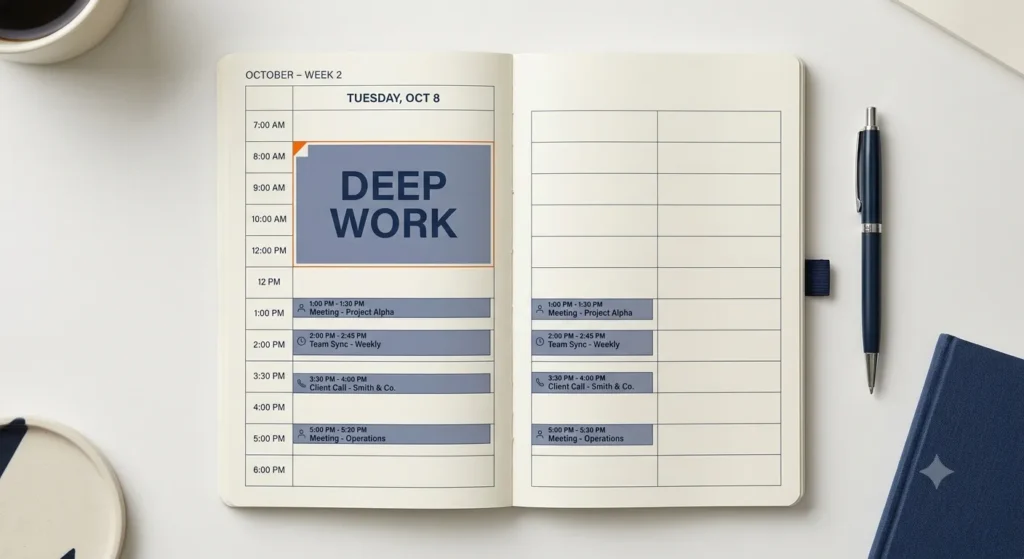
Uninterrupted blocks of ninety minutes to two hours, with notifications off and no meetings, consistently show up in how highly productive people structure their most important work. The block is treated as fixed, similar to an important meeting, rather than something that gets bumped whenever something else comes up.
habit three, a consistent weekly review
A short weekly review, often just fifteen to twenty minutes, to look back at what worked, what did not, and what the coming week’s single priority should be, shows up repeatedly among people who sustain high output over years rather than just a few intense months.
habit four, managing energy, not just time
Highly productive people frequently schedule their hardest, most important work during their natural energy peak, often morning for many people, and save lower energy periods for administrative tasks, email, or meetings. Time management alone ignores that not all hours carry equal focus capacity.
habit five, saying no early and often
Protecting a small number of priorities requires declining a much larger number of requests, meetings, and opportunities than most people are comfortable with. This habit is less visible than the others, but it is often the one that makes the rest possible.
real life example: how elena reclaimed her mornings
Elena, a 35 year old startup operations lead, used to start every day by opening her inbox, which meant her mornings were dictated entirely by other people’s requests before she had done any of her own priority work. Her most important projects consistently slipped to evenings, when she was already exhausted.
She made one change: her calendar now blocks the first ninety minutes of every workday as deep work, with email closed and notifications off, protected as firmly as a client meeting. Six months later, her highest priority projects finished during the day rather than bleeding into her evenings, without her working more total hours, simply protecting a smaller portion of the day more deliberately.
your productivity habit starter plan
- Step 1: Each evening, write down the single priority that would make tomorrow a success.
- Step 2: Block ninety minutes on your calendar for that priority during your natural energy peak, treated as fixed.
- Step 3: Turn off notifications during that block, and close email until it ends.
- Step 4: Run a fifteen minute weekly review every Friday to set next week’s single priority.
adapting these habits to a standard nine to five job
Not everyone can block ninety minutes of uninterrupted focus whenever they want, especially inside a job full of scheduled meetings. The habits above still apply, just at a smaller scale. Even a single thirty minute block placed before the first meeting of the day, with your phone in another room, delivers a meaningful amount of the same benefit.
The weekly review also compresses well into a busy schedule. Ten minutes on a Friday afternoon, spent simply listing what actually moved forward that week and picking one priority for Monday, is often enough to keep the whole system from drifting, even without the full hour some productivity guides recommend.
The core principle stays the same regardless of job type or schedule, protect a smaller number of things more consistently, rather than trying to protect everything a little.
common mistakes that undermine productivity habits
- Starting the day by opening email instead of deciding the day’s single priority first
- Scheduling important focus work during naturally low energy hours
- Saying yes to too many requests, leaving no protected time for priority work
- Skipping the weekly review, which causes priorities to drift week over week
Productivity habits are simply habit formation applied to work. The complete guide to self-improvement habits covers the underlying mechanics of how any of these habits actually stick.
Protecting a deep work block every day, even on low energy mornings, is a direct application of the discipline vs motivation guide, since these blocks rarely feel exciting, they simply get protected regardless.
Energy management, one of the habits above, connects closely to the broader guide on healthy habits that improve mental and physical wellbeing, which covers sleep and movement in more depth.
recommended resources
A few tools make these habits easier to maintain consistently:
Useful for blocking deep work time and treating it as fixed rather than flexible.
Helps protect the deep work block described above by making distractions more visible when they interrupt it.
frequently asked questions
do highly successful people really wake up at five a.m.
Some do, but the wake up time itself matters far less than protecting a consistent block of focused time, whatever hour that happens to be for a given person.
how many priorities should I focus on each day
Most highly productive people narrow it down to one single top priority, with everything else treated as secondary.
what if my job does not allow a fixed deep work block
Even a protected thirty minute block, defended consistently, delivers meaningfully more focused output than scattered attention throughout an unstructured day.
is multitasking part of a productive routine
No. Research consistently shows that switching between tasks reduces overall output and increases errors, compared to single tasking during a protected block.
how often should I do a weekly review
Once per week is generally enough. Fifteen to twenty minutes at a consistent time, often Friday afternoon or Sunday evening, works well for most schedules.
does energy management really matter more than time management
Both matter, but scheduling demanding work during low energy hours often wastes the time slot even if it is technically available.
is saying no a productivity habit
Yes. Protecting time for priorities almost always requires declining other requests, which is why it is one of the more consistent habits among highly productive people
The real productivity habits of highly successful people are less about doing more and more about protecting less, a single daily priority, a defended block of deep focus, and a consistent weekly review to keep it all pointed in the right direction. None of it requires waking up at five a.m., it requires deciding what matters and defending that decision daily.